Festival in Washington (1968)
We hope you will enjoy the following film. Please consider making a donation so that we can continue preserving films and presenting them on our Web site. Thank you!
The film will start in 0 seconds.

Film showing the Bayshore Amusement Park in its heyday, preserved by the Maryland Historical Society with NFPF support.
We hope you will enjoy the following film. Please consider making a donation so that we can continue preserving films and presenting them on our Web site. Thank you!
The film will start in 0 seconds.
Festival in Washington (1968)
Production Company: Eli Productions. Producers: John O’Toole and Jim Helliwell. Sponsor: The Office of Public Affairs, Smithsonian Institution. Narrator: Robert Burr. Participants in order of appearance: Ed, Lonnie & G.D. Young (fife and drum group); St. Nickola Dancers (Serbian dance group); Bill McElreath (clog dancer) and Red Parham (harmonica and guitar); Dewey Shepherd (fiddle); Ernie Cornelson (potter); Russell Fluharty (hammer dulcimer); Isaac Doss (blacksmith); Mance Lipscomb; Wally Kiser (sorghum maker); Skip James; Muddy Waters; Russell Cartee (shingle-maker); Fred Cockerham and Thomas Jarrell (string band; audio only); Mrs. Roy Harris, Mrs. Charles Morland, and Mrs. Thelma Hall (doll makers); Thonius Robinson (basket maker); Doc Watson and Jean Ritchie; Jack Matthews (sheep shearer); Elsia Trivett and Gladys Clark (wool carder and spinner); Alma Barthlemy (Creole singer, audio only); Norman Kennedy and Cape Breton Milling Singers (Gaelic singers). Transfer Note: Scanned from a 16mm Ektachrome print preserved by the Center for Folklife and Cultural Heritage, Smithsonian Institution. Running Time: 21 minutes.
In the summer of 1968, a special event brought a respite of musical calm to a year cursed by the assassinations of Martin Luther King Jr. and Robert F. Kennedy, protests over an unpopular war abroad, riots over racial injustice, and a tumultuous, close-run Presidential election. That event was the second annual Festival of American Folklife, organized by the Smithsonian Institution and held on the National Mall in Washington D.C. on the Fourth of July. It occurred only nine days after the Mall’s prior event, the tent encampment “Resurrection City,” comprised of more than 5,000 protestors from the Poor People’s Campaign and organized by the Southern Christian Leadership Conference to fulfill the final project of Martin Luther King, who’d given his “I have a dream speech” in that very space. Both events were eminently suited to the National Mall, described by former Secretary of the Interior Bruce Babbitt as the “symbolic center of our country.”
Holding the Festival of American Folklife on the Mall was part of Smithsonian head S. Dillon Ripley’s goal of enlivening the site as a public space, a goal fully met: the Festival has been held on the Fourth of July every year up to 2025. Ripley was said to have told the Festival’s founding director Ralph Rinzler to “take the instruments out of their cases and let them sing.” The 1968 edition was intended to be “a living exhibition of the creativity of the many ethnic groups that make up the culture of this country,” with a program spotlighting Texas.
Documenting the Festival on film was part of Ripley’s efforts to stimulate motion picture productions revolving around the Smithsonian’s collections, exhibits, and events. The starting point was commissioning a short documentary by Charles and Ray Eames, The Smithsonian Institution (1965). A different approach was taken with Festival in Washington. It was the first production of the Smithsonian Institution Motion Picture Unit, established through a contract arrangement with Eli Productions to produce films for general distribution and/or public television on a variety of Smithsonian-related topics. As the Institution put it, “Eli Productions will invest the funds and conception-to-completion film production capabilities. The Institution will invest time and intellectual resources in terms of collections and staff cooperation, and share in possible profits.”
Eli Productions, already based in Washington D.C., was a specialist in what its filmmaking partners John O’Toole and Jim Helliwell called “public affairs broadcasting.” It handled filming for the Public Broadcast Laboratory of National Educational Television and provided motion picture services for Hubert Humphrey’s Presidential campaign. For their new enterprise O’Toole and Helliwell took offices in the film production and broadcast center within the Smithsonian’s National Museum of History and Technology (now the National Museum of American History). Festival in Washington was warmly received and won the Golden Eagle, the top award from the Council on International Non-theatrical Events (CINE). It also screened widely at film festivals, effectively promoting the Festival and Institution.
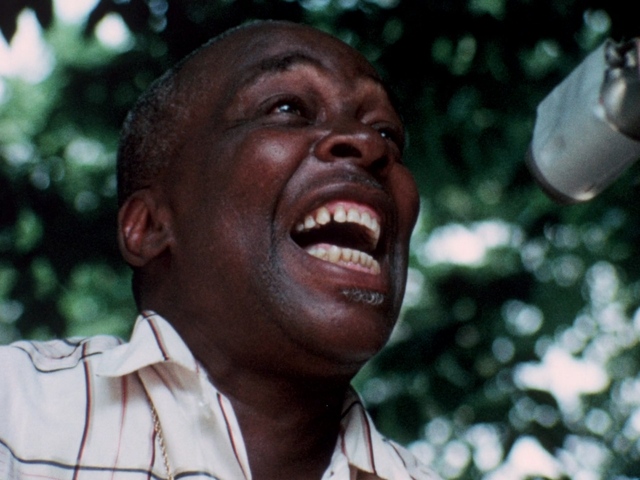
Festival in Washington’s most impressive feat is squeezing an eclectic panorama of crafts folk and musicians into a mere 21 minutes, efficiently overlaying audio of the musical performances onto visuals of the crafts demonstrations before cutting to footage of the musicians. The resulting juxtapositions bring together subjects from thoroughly different areas of the country and folk art. Among the musicians—“artists who are neither pop nor quaint”—are folk legends Doc Watson and Jean Ritchie, who duet on the Carter Family’s “The Storms Are on the Ocean,” and three blues titans: Mance Lipscomb (representing Texas and singing “Motherless Children”), Skip James (“Crow Jane”) and Muddy Waters (“Honey Bee”).
The narration, spoken by Robert Burr, leans heavily on nostalgia, portraying the Festival as an idyll of pre-industrial, pre-commercial society, “a world where people hardly ever bought anything—there was someone there who made things.” The visuals agree, showing “children who had hardly ever seen music or anything else made by a pair of human hands” watching with rapture as crafts folk perform tasks everywhere else performed by “machines, which cannot sing.” But as modern viewers might realize, the distance between 1968 and the film's vision of the folk world is matched by the distance between 1968 and today. The narrator, referencing Henry Wadsworth Longfellow’s once famous poem “The Village Blacksmith,” notes how few blacksmiths are left and complains “the children of suburbia might as well read poems about punch-card operators standing under conveyor belts.”
Punch-cards are now as outdated as blacksmiths, but the Festival of American Folklife lives on. Every year between 1967 and 2025 it was held on the Fourth of July at the National Mall. But in 2026 the tradition was broken, when its place on “the nation’s lawn” was taken by The Great American State Fair. To compensate, the Festival launched “Of the People: The Smithsonian Festival of Festivals.” This initiative, lasting from March to November, is a collaboration between the Center for Folklife and Cultural Heritage and 34 festivals across the country, held on lawns spanning our nation and its many cultures.
About the Preservation
Festival in Washington was preserved by the Center for Folklife and Cultural Heritage from the highest-quality surviving print, with sound elements synchronized from original ¼” open reel audiotapes of sync sound roll recordings corresponding with camera elements, along with the original magnetic 16mm film soundtrack. Colorlab, after scanning the print in 4K, output the file back to film to create a new negative and print, while Audio Mechanics handled audio restoration. Selections from the newly preserved film were screened at the 2025 Smithsonian Folklife Festival on the National Mall.
Further Viewing
Fiddler Tommy Jarrell and banjoist Fred Cockerham are heard but not seen in Festival in Washington. For footage of the duo performing on a front porch, see Jarrell and Cockerham (1971), preserved by University of North Carolina at Chapel Hill through a 2019 NFPF grant.