Paris Green (1920)
We hope you will enjoy the following film. Please consider making a donation so that we can continue preserving films and presenting them on our Web site. Thank you!
The film will start in 0 seconds.

Film showing the Bayshore Amusement Park in its heyday, preserved by the Maryland Historical Society with NFPF support.
We hope you will enjoy the following film. Please consider making a donation so that we can continue preserving films and presenting them on our Web site. Thank you!
The film will start in 0 seconds.
Paris Green (1920)
Production Company: Thomas H. Ince Productions. Distribution Company: Paramount Pictures/Artcraft Pictures. Producer: Thomas H. Ince. Director: Jerome Storm. Writer: Julien Josephson. Cinematographer: Chester Lyons. Editor: Harry L. Decker. Title Artists: F.J. Van Halle, Carl Schneider, Leo H. Braun. Art Director: W.L. Heywood. Technical Director: Harvey C. Leavitt. Cast: Charles Ray (Luther “Paris” Green), Ann May (Ninon Robinet), Bert Woodruff (Matthew Green), Gertrude Claire (Sarah Green), Donald McDonald (Jules Benoit), Gordon Mullen (“Hairpin” Petrie), Norris Johnson (Edith Gleason), William Courtright (Malachi Miller), Ida Lewis (Mrs. Miller), Otto Hoffman (Andre Robinet). Transfer Note: Copied at 18 frames per second from a 35mm preservation print by George Eastman Museum. New Music: Ben Model. Running Time: 62 minutes.
The late 1910s and early 1920s were the heyday of rural films, melodramas and comedies set in America’s farms, hamlets, and small towns. The census of 1910 showed that 54.4 percent of the population still lived in rural areas, but urbanization was eating away at that figure each year, further widening the social divide between the city—with its immigrants from southern and eastern Europe, its modernism, its consumer culture—and the countryside, the home of “traditional” values based on agricultural life. Rural films helped Americans look across that divide, since they were also popular in the bigger cities where many of the residents had memories of the farm. The films validated rural lives and insisted on the moral superiority of country folk (while poking good natured fun at them) but also insisted that rural morality could be successfully transplanted to the city. Rural films additionally facilitated modernization by viewing rural life through an increasingly nostalgic haze of youth and childhood, relegating it to the personal and/or historical past.
Among the most famous rural films, familiar from film history textbooks, are D.W. Griffith’s A Romance of Happy Valley (1919), True Heart Susie (1919), and Way Down East (1920), and Henry King’s Tol’able David (1921). Less discussed are those starring the actor most associated with the rural film, in his embodiment of the country boy: Charles Ray. If Mary Pickford was “America’s Sweetheart,” Ray was the male equivalent in farm clothes and a straw hat. When Paris Green, an exemplar of the dozens of rural films starring Ray, was released in June 1920, it prompted appraisals such as this from Frederick James Smith, editor and critic of Motion Picture Classic:
You and I have come to look upon his bashful, awkward, small-town boys as regular incidents of photoplay releases. Yet they are far more. Ray takes the most colorless sort of role and galvanizes it into life. There is nothing of the theater or studio about him. He is small-town youth—the sort of youth upon which America depends. He is a master player because he is able to reflect this so humorously, so tenderly, so sincerely…Ray is a genre player of genius. He is typically American. No mere heroic manikins are his screen creations. He turns the characters inside out and shows you the affectations, the weaknesses, the boyish foibles, the very thoughts of his creations, along with the outer shell.
This was not an isolated reaction. Another influential critic, Herbert Howe of Picture-Play, greeted the film by proclaiming Ray “the greatest actor on the screen,” and even foreign critics concurred, with the British Kinematograph Weekly calling Ray “one of the few true geniuses of the screen.” In Europe Ray’s fans included Rene Clair and Ernst Lubitsch: “In Germany, I think, we have nobody who is so fine. He has nuance, what you call shading.” Thanks to his gifts Charles Ray had triumphed as the screen avatar of rural America. But after 1920 his triumph would turn into a trap he eagerly sought to escape.
Ray owed his start and rise in rural films—and films altogether—to the independent producer Thomas Ince, who hired him in 1913. Starting as an extra, Ray progressed to varied roles in every type of movie Ince produced. The Coward (1915), a civil war drama with Ray in the title role, made him a star, thanks to his subtle, naturalistic performance (“not to mug or gesture, but simply to think,” was how Ray described his acting). Hailed as “Tom Ince’s New Wonder-Boy,” Ray experienced his first bout of typecasting. “You see, when an actor makes a success in a certain line of work, producer and public conspire to keep him in it. Weaklings and boobs have been my portion ever since the critics took kindly to me in The Coward,” he explained. “I am happy and grateful over it. But I’m eager to prove that I can do other parts just as well.”
Those opportunities narrowed after the smash success of The Pinch-Hitter (1917), where Ray played a put-upon farm boy who goes to college and enjoys the first great success of his life on the baseball diamond (the film would later influence Harold Lloyd’s The Freshman, just as Ray’s role in The Coward influenced Buster Keaton’s in The General). In 1917 Ince signed a distribution contract with Paramount that resulted in a multi-year series of Ray vehicles, totaling 22 films by the end of 1920.
Ray was permitted to play against type on occasion. He played a well-heeled heir coming into money—and alcoholism—in The Family Skeleton (1918), as well as a cossetted man-about-town who makes a bet to experience harrowing poverty in The Millionaire Vagrant (1917). But it was clear that audiences loved Ray most when he played the sort of “young man such as everyone had known at one time or another,” as Ince noted, with “the shyness, the awkwardness, the simplicity of thousands of our American youths.” Ince proclaimed that with Ray he could “give the public a star who was closer to them than the forced masculinity and obvious good looks of those who were popular.”
Though Ray’s rural films were crowd-pleasers, they were more than simple, cozy celebrations of rural life. In The Clodhopper (1917) Ray escapes the farm of his tyrannical father to earn success in the city as a dancer, making enough money to save his undeserving old man from financial ruin during a return visit. In Homer Comes Home (1920), Ray returns from the city to his small hometown and finds it as hypocritical, suspicious, and small-minded as when he’d left. And in Paris Green (the title is a pun on the pigment Paris Green, used for painting and insecticide) Ray is a soldier who returns to rural life to find disappointment, along with temptation to leave for the city.
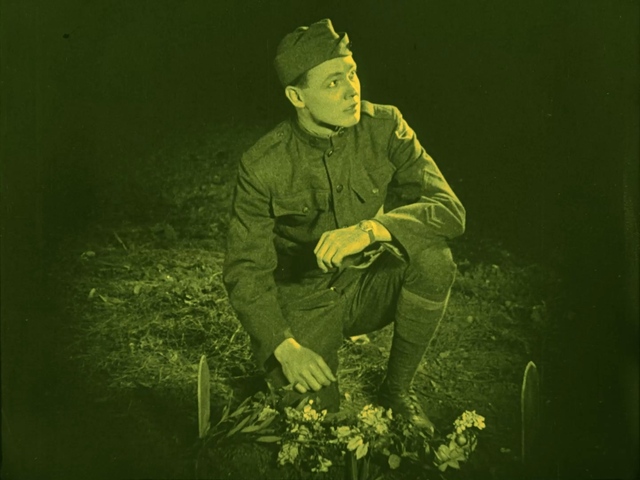
As Variety noted, the film was obviously inspired by the 1919 hit song “How are You Goin’ to Keep 'Em Down on the Farm (After They’ve Seen Paree)?” Ray is Luther “Paris” Green, a war hero returning from France to his (fictious) hometown of Quigley Corners, New Jersey. Everyone assumes Luther can now “rattle off that French lingo like a reg’lar perfesser,” and he goes along with them, despite having spent only 42 minutes in Paris. Luther is a country boy pretending to be a sophisticate, while the residents of Quigley Corners betray the stereotypical small town inferiority complex toward the city (in this case, a famed foreign city), compounded of envy and suspicion. Luther’s homecoming proves a disappointment: he arrives at the train station to find no one waiting for him, finds out his dog is dead, and learns that his sweetheart who'd promised to wait didn’t.
“I’m afraid Luther won’t be content here on the farm—after him livin’ so long in Paris,” admits his mother, and sure enough, despite actually having spent so little time in Paris, Luther decides to take the midnight train to the nearest available city, New York. On the way to the station he runs into Ninon, the Frenchwoman he’d briefly met in Paris, and changes his mind. It turns out that the best way to “keep ’em down on the farm after they’ve seen Paree” is to import a girl from there. Ninon replaces Luther’s faithless American sweetheart and represents a youthful injection of new blood into the old farm town. Luther and Ninon fall in love while discovering the beauty of the countryside. At a bucolic creek-side picnic, Luther fully reverts to his old farm clothes and floppy straw hat.
The film argues that the natural beauty of the country compensates for the flaws of country folk. Luther’s father is a bumpkin, albeit an amiable one, and the other residents of Quigley Corners are either falsehearted (Luther’s sweetheart) or the sort of backbiting gossips who assume that since Ninon is French “she’s one o’them highkickers he met there!” The only non-comedic and morally impeccable resident of Quigley Corners is Luther’s saintly mother, though the film (as usual, avoiding overstatement in its case for rural life) downplays the sentimentality inherent in the character. In the best example, the reunion of Luther and his mother is staged from a distance, in a single shot over a minute long. As directed by Jerome Storm (who also got his start with Ince; this was his 10th film out of 16 with Ray), the scene relies on spatial continuity and duration to convey extreme emotion, rather than the over-emphasis of the close-up. Storm takes the same strategy in the reunion of Luther and Ninon, which occurs entirely in an irised long shot.
Urbanization-in-reverse occurs in Paris Green, as Luther and Ninon move from the city to the farm. The finale brings together the country yokels with Ninon’s elegant city slicker uncle, and shows Luther riding to the rescue on a white horse, having fully become a country hero. The film, having shown the merits and demerits of rural life, shows how it's revitalized by young people returning from the city. Along the way we see that mom’s flapjacks can be just as tasty as “those fancy French vittles,” and that a barn dance in Quigley Corners can be as exciting as a can-can in Paris (thanks to Ray’s footwork, which recalls his eccentric hoofing in The Clodhopper).
Paris Green met with a predictably enthusiastic response from small town exhibitors (“one of the best pictures I have ever played,” according to one in Des Moines, New Mexico). But reviewers in the trade press found the plot “arbitrarily developed” or formulaic, and wondered if scenarist Julien Jospehson, who’d written eight previous films for Ray, had run out of steam. “A creaking skeleton of a story it is. But Ray makes you believe in it,” concluded the afore-quoted Frederick James Smith.
Like those critics, Ray believed he could appear in better films. Around the time of Paris Green’s release, he amicably parted from his mentor Thomas Ince, explaining “I must start my own grocery store.” He set up not only his own production company, but his own studio. Ray attempted to be his own Thomas Ince, fully controlling his films and image, and between 1920 and 1923 he produced and starred in 16 films. Of these he directed nine, some negatively received, though the sole surviving example of his direction, Smudge (1922), is qualitatively and technically on par with the Ince films.
The problem might have been that Ray was playing roles further away from his familiar country boy characters, though he still tried to appease the audience by returning to rural characters in two of the best-remembered films of his entire career, both directed by Joseph De Grasse. The Old Swimmin’ Hole (1921), believed to be the first feature without intertitles, was a warmly nostalgic portrait of boyhood and village life, while The Girl I Loved (1923) was an equally nostalgic but pathos-filled adaptation of a James Whitcomb Riley poem. Critics acclaimed it as Ray’s masterpiece. Then, following cinematic trends toward costume pictures and super productions, Ray sank his money into The Courtship of Miles Standish (1923), based on the Longfellow poem and set in the days of the Mayflower. The film's failure ended Ray’s career as a producer, along with his studio. He returned to the employ of Thomas Ince, who cast him in two films, not as country boy but an innocent milquetoast forced to “man up” in unusual settings. But Ince’s sudden death in 1924 further derailed Ray’s career. He reverted to playing “country boobs,” first for the small independent Chadwick, which reteamed him with Jerome Storm, and then MGM. But returning to his old roles wasn’t enough to fully return his stardom.
The reason why dates back to 1920. During that year the percentage of Americans living in rural areas (48.8) slipped for the first time below urban ones and continued slipping: a decade later the population was 56 percent urban. 1920 was also near the start of the agricultural depression that struck rural America and persisted into the 1930s, marked by price deflation resulting from wartime overproduction and Europe’s postwar recovery. Half a million farms would go bankrupt in the ’20s. Rural America increasingly became a place to escape from, and for many moviegoers had lost its bucolic glow, especially since the cities were enjoying a Jazz Age boom. Roughly 20 percent of American films made in 1915 had been set in small towns; by 1930 only five percent were. A film like Paris Green, with its argument for rural life, was upended and falsified by the reality of the 1920s. The real-world versions of Luther Green left the farm and Ninon stayed in France. By the decade's middle the decline of the rural film and rural America had turned Charles Ray’s innocent country boys into relics.
Sensing this, MGM tried Ray in other roles, such as the urban, working-class fireman in The Fire Brigade (1926), and in two films cast him against type as a millionaire sophisticate. After Ray went freelance he continued with white-tie-and-tails roles for the rest of the silent era, playing the leading man in comedies starring Leatrice Loy, Marie Provost, and Corinne Griffith. In 1927 Ray observed he hadn’t played a rural role in more than a year, and that was fine with him. “I don’t mean to go back to it. I’m going to play men’s roles and wear good clothes.” Ray had played the country boy far too well for the public to be comfortable seeing him as an urbane man, but at least he could swap his straw hat for a topper and enjoy his escape.
About the Preservation
The George Eastman Museum preserved Paris Green from a 35mm nitrate print, retaining its tinting. The project, commenced in 2000, was funded by Saving the Silents, a collaborative project organized by the NFPF and supported by the Save America’s Treasures program, a partnership between the National Endowment for the Arts and the National Park Service, Department of the Interior. Further funding was provided by the Eastman House Council. A more recent NFPF grant funded digitization of the preserved print.
About the Musician
Ben Model is one of the nation’s leading silent film accompanists, performing on both piano and theatre organ. Over the past four decades, he has created and performed thousands of live scores for silent films at historic theaters, museums, and universities, and has composed several silent film scores for orchestra and concert band. He is a resident film accompanist at the Museum of Modern Art (NY) and at the Library of Congress’ Packard Campus Theatre, and is a regular at the TCM Classic Film Festival, Capitolfest, and the Kansas Silent Film Festival. Ben’s Blu-ray label Undercrank Productions works with archives and collectors to bring undiscovered gems of silent cinema to fans. He is the accompanist, producer and conceiver of the long-running The Silent Clowns Film Series in NYC, host of The Silent Film Music Podcast, and a Visiting Professor of Film at Wesleyan University, where he teaches a course on silent film history. His book The Silent Film Universe was published in 2025.
Further Reading
“Rural America on the Silent Screen” by Hal S. Barron (Agricultural History, vol. 80, no. 4, 2006) incisively examines how rural films created a new view of agrarian life for American audiences. In lieu of a biography of Charles Ray, the best sources are Thomas Ince: Hollywood’s Independent Pioneer by Brian Taves (University Press of Kentucky, 2012), and the biographical profile of Ray in Dewitt Bodeen’s More From Hollywood! (A. S. Barnes and Co., 1977). During the twilight of his movie career in the 1930s, Ray wrote two works of fiction, both available on the Internet Archive: the caustic anthology Hollywood Stories (1935), “Compiled from Incidents in the Everyday Life of Men and Women who Entertain in Pictures,” and Flowers for the Living (1937), a Hollywood novel about a washed-up movie star and a starving actress, brought together in suicidal despair.
Further Viewing
The Village Sleuth (1920), starring Charles Ray and released by Thomas Ince a few months after Paris Green, is available for viewing, as an online video digitized from a print at the Library of Congress and presented by Ed Lorusso. For an example of one of Ray's “dress suit performances,” see The Garden of Eden (1928). Starring Corinne Griffith and directed by Lewis Milestone, the film was recently restored by the San Francisco Film Preserve and released on Blu-Ray by Flicker Alley.