My Lady's Lips (1925)
We hope you will enjoy the following film. Please consider making a donation so that we can continue preserving films and presenting them on our Web site. Thank you!
The film will start in 0 seconds.

Film showing the Bayshore Amusement Park in its heyday, preserved by the Maryland Historical Society with NFPF support.
We hope you will enjoy the following film. Please consider making a donation so that we can continue preserving films and presenting them on our Web site. Thank you!
The film will start in 0 seconds.
My Lady’s Lips (1925)
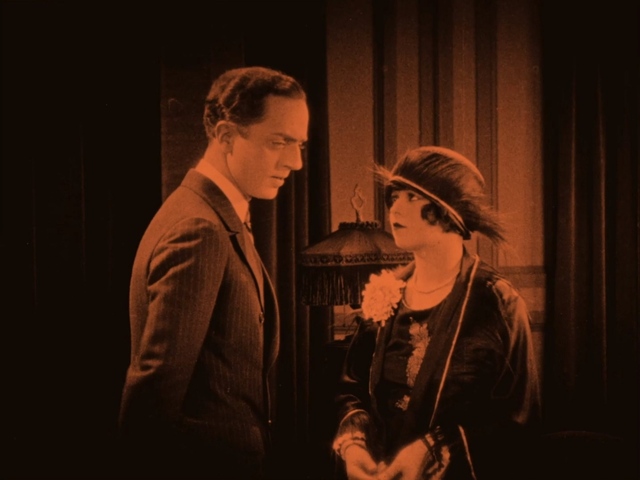
Production Company: B.P. Schulberg Productions Inc./Preferred Pictures. Producer: B.P. Schulberg. Director: James P. Hogan. Scenario: John Goodrich. Director of Photography: Allen Siegler. Art Director: Frank Ormston. Cast: William Powell (Scott Seddon), Alyce Mills (Dora Blake), Clara Bow (Lola Lombard), Frank Keenan (Forbes Lombard), Ford Sterling (“Dutch” Smike), Matthew Betz (Eddie Gault), Gertrude Short (Kit), Sōjin Kamiyama (Ching Lee), John Sainpolis (Inspector Neilan). Transfer Note: Scanned from a 35mm print preserved by UCLA Film & Television Archive. New Music: Ben Model. Running Time: 83 minutes.
For William Powell and Clara Bow, My Lady’s Lips was another sector in the waiting room of stardom. Upon entering movies in 1922, Powell had almost exclusively played heavies or unsavory supporting characters: “I had a wonderful sneer and a leer which registered perfectly. So, I became a villain.” Up to 1925 he’d filmed on the east coast to accommodate his stage career, but that year the independent producer B.P. Schulberg persuaded Powell to visit Los Angeles to make two films. The bait was irresistible: in both movies Powell would be the leading man, an entirely sympathetic one. Since the first film, Faint Perfume, is lost, My Lady’s Lips stands as William Powell’s first heroic turn onscreen.
B.P. Schulberg—who’d started his own production company, Preferred Pictures after losing his excutive position during a power struggle at Paramount—had spotted a potential star, one who could be hired for not too much money by a low-budget concern such as his own. For the most important supporting role in My Lady’s Lips, Schulberg turned to one of his up-and-coming contract players, Clara Bow, who he'd signed in 1923. A year later he gave Bow her first leading role in Hollywood, in Poisoned Paradise, while keeping her on a treadmill of assignments. My Lady’s Lips was the third of 14 features Bow appeared in during 1925. For eight of these she was loaned out to other studios, a lucrative practice that could net Schulberg a 500 percent profit for her services.
In My Lady’s Lips Bow plays a flapper ensnared by an underworld gang. She asks her father, a powerful newspaper publisher, for help; he in turn enlists his star reporter, played by William Powell, to infiltrate the gang’s underground hideout. Powell’s character is captured and saved by the gang’s female ringleader, with whom he falls in love and hides from the law. That gangstress was played by Alyce Mills, whose short career lasted from 1924 and 1928, taking in 17 films before her marriage and retirement. “She is thoroughly in character, and has an effective manner of curling an otherwise tempting mouth into a sneer that lends her the appearance of a veritable wolf of the underworld,” wrote Exhibitors Trade Review.
Schulberg was evidently on a roll, or wanted everyone to think he was, since he announced Preferred Pictures would expand its slate of films for the 1924–25 season from nine to 16. His studio had two production units, headed by Louis Gasnier and My Lady’s Lips director James P. Hogan, and he kept them continually at work. Hogan, described in the press as a “a giant Irishman,” was injured in a car accident prior to My Lady’s Lips; unable to walk with sprained ankles, he directed most of the film from a wheelchair. Since the studio lacked a distribution arm, My Lady’s Lips, like Schulberg's other productions, was released through the "states rights" method of selling titles on a territorial (often state by state) basis to local exchanges.
“The title has very little to do with the production,” noted one reviewer, for good reason. In July 1923, the upcoming My Lady's Lips was promoted in trade press advertisements as “a story of gossip” by one Edward Locke. A few months later the screenwriter was now listed as Olga Printzlau, and a few more months later as Eve Unsell. Final credit for the original story and scenario was assigned to James Goodrich. Perhaps this indicated a troubled script history, or perhaps only the title had been devised in 1923. In any case, reviews from eight of the major trade publications agreed that the tortuous story was longer than it needed to be and not always convincing. “A crook drama that is lively and often amusing. But we dare you to try to believe in the plot,” wrote Photoplay, while Film Daily noted “much of the action has an unreal, movieish flavor.”
Critics also knocked the beginning of the film for “confusion caused by introduction of superfluous characters” (Motion Picture News) but praised the atmospheric, suspenseful sequence in the villains’ lair, especially the scenes of William Powell shamming blindness. The actor’s new type of role also received notice: Variety insisted “William Powell is badly miscast as the hero, he being the villain type,” but most other reviews thought him “well cast” while lamenting that “Clara Bow, with the biggest eyes in the world, has little to do” (Exhibitors Trade Review). Modern audiences will agree. The scenes of Bow with her screen father, played by the venerable Broadway star Frank Keenan, create sparks through the difference in acting styles: Keenan’s intimidating deliberation is strangely complementary to Bow’s unguarded, raw-nerve emotion. The performers share an intensity that leaves the viewer wanting more scenes with them. Bow's three scenes with William Powell, though more courtly, inspire the same reaction.
My Lady’s Lips further convinced Schulberg of Powell’s value, and after Schulberg returned to Paramount a the end of 1925 he signed Powell to an exclusive, long-term contract. The next year Powell made eight films, including his last leading man role of the silent era (in White Mice) and his second (and last) film with Clara Bow, The Runaway. Powell continued playing villains and supporting parts—such as Boldini in Beau Geste (1926) and the revolutionary-turned-film-director in The Last Command (1928)—before the coming of sound, when the revelation of his voice made audiences receptive to actor's reinvention as a debonair leading man. Clara Bow spent less time in stardom’s waiting room: she only had to wait to the end of 1925, when The Plastic Age made she became a full-fledged star. She also went along with Schulberg to Paramount, and would make her best known films there.
While My Lady’s Lips had plenty of incipient star power and “movieish flavor,” reviewers also noticed its lurch into social commentary during the scenes of police using “the third degree” (in this case 48 hours without food, water, and sleep) to coerce false confessions from Powell and Alyce Mills. The police also use the good cop/bad cop routine but with the sinister touch of the bad cops wear masks. The film visually editorializes by dissolving from the interrogation room to a medieval torture chamber, creating a visual metaphor between the gesticulating cop waving an accusatory arm and pointed finger at Powell and the hooded executioner waving his whip at Powell's back. Some reviewers expressed doubt (perhaps naïve) on the plausibility of police torturing a well-known member of the fourth estate: “there never existed a star reporter so utterly friendless that the cops would dare to man-handle him like a tramp or branded convict,” claimed Motion Picture News.
But for Schulberg the sequence was a good blend of sensationalism and social conscience. His prior hit Capital Punishment (1925) was an anti-death penalty melodrama about an innocent man on death row, and Like My Lady’s Lips was directed by James Hogan, scripted by John Goodrich, and featured Clara Bow. Moreover, the topic of police torturing a confession from an innocent victim had long-proven commercial potential, dating from Charles Klein’s 1909 Broadway smash The Third Degree, itself inspired by the case of Richard Ivens, who was tried, convicted, and executed for the rape and murder of a Chicago woman in 1906. The prosecution’s case depended on a confession Ivens later repudiated, and famed psychologist Hugo Münsterberg was among many who believed the police had pressured an intellectually disabled subject into believing a falsehood. In Klein’s The Third Degree a weak-minded man admits to a murder he did not commit, following a harsh police interrogation. The idea was every bit as sensational onscreen, inspiring D.W. Griffith’s Biograph short The Burglar’s Dilemma (1912) and three adaptations of the play in 1913, 1919, and 1926, the latter a year after My Lady’s Lips.
Schulberg’s depiction of the third degree involved some caution, since an intertitle attempted to avoid offending the police by claiming the third degree was “hated by the police themselves.” To give official sanction and respectability to the film, and avoid charges of sensationalism, Schulberg prefaced the interrogation scenes with footage of August Vollmer, “noted criminologist and prison reform advocate—ex-President, International Association of Police Chiefs,” pounding his desk and announcing, “the brutality of the Third Degree must give way to a more scientific and humane method of crime detection.”
One of the most famous progressive police reformers of the era, Vollmer had shot to prominence after becoming the first police chief of Berkeley, California in 1909. Over the ensuing years he helped create the nation’s first policing educational program and was among the earliest adopters and proponents of higher education for officers, pre-delinquency programs, radio communications, centralized records systems, forensic analysis, computational machines, the lie detector, and the hiring of African American officers. Vollmer argued that the modernization and professionalization of the police, with technology such as the polygraph, eliminated the need for coerced confessions, which he had a point of banning in Berkeley, telling his officers “Never hit a person except in self-defense. If you do, you have just resigned.”
Vollmer would have been especially familiar to Schulberg and the rest of Hollywood because he had served as the police chief of Los Angeles, leaving after a one-year term (1922–23) where his reorganization and anti-corruption efforts had been frustrated by the mayor and city officials. (He’d also ruffled feathers in the department by making every officer take an IQ test—several scored single digits). But during his time in office he’d succeeded in founding the nation’s first crime lab and a minimum-security prison more humane than anything else offered by the city. Vollmer endorsed My Lady’s Lips by stating, “it is interesting and as technically authentic in its picturization of the third degree as that sort of thing can be filmed.” Nor was he done with movies: a year later he appeared in the 10-part serial Officer 444, directed by Francis Ford and starring Ben F. Wilson. And in 1931 Vollmer was commissioned by Will H. Hays to study if gangster films exerted a criminal influence on juveniles and/or placed law enforcement in a negative light. Vollmer concluded that the films were more likely to make youth hesitate to take up a life of crime and that they made the police look more capable than they probably were. Viewers might be tempted to see how that verdict applies to My Lady’s Lips.
About the Preservation
My Lady’s Lips was preserved by UCLA Film and Television Archive and the Stanford Theatre Foundation from two tinted nitrate prints, one of which was provided by George Eastman Museum as part of Saving the Silents, a project organized by the National Film Preservation Foundation and supported by the Save America’s Treasures program, a partnership between the National Endowment for the Arts and the National Park Service, Department of the Interior. Further support was provided by David W. Packard and David Stenn. A recent NFPF grant funded scanning and digitization of the preservation print.
About the Musician
Ben Model is one of the nation’s leading silent film accompanists, performing on both piano and theatre organ. Over the past four decades, he has created and performed thousands of live scores for silent films at historic theaters, museums, and universities, and has composed several silent film scores for orchestra and concert band. He is a resident film accompanist at the Museum of Modern Art (NY) and at the Library of Congress’ Packard Campus Theatre, and is a regular at the TCM Classic Film Festival, Capitolfest, and the Kansas Silent Film Festival. Ben’s Blu-ray label Undercrank Productions works with archives and collectors to bring undiscovered gems of silent cinema to fans. He is the accompanist, producer and conceiver of the long-running The Silent Clowns Film Series in NYC, host of The Silent Film Music Podcast, and a Visiting Professor of Film at Wesleyan University, where he teaches a course on silent film history. His book The Silent Film Universe was published in 2025.
Further Reading and Viewing
For biographies of Clara Bow and August Vollmer, see David Stenn’s Clara Bow: Runnin’ Wild (Cooper Square Press, 2000) and August Vollmer: The Father of American Policing by Willard Oliver (Carolina Academic Press, 2017). Available on the NFPF website are the surviving reels of Clara Bow’s first film for Schulberg, Maytime (1923), and the complete feature that marked Bow's first leading role in Hollywood: Poisoned Paradise: The Forbidden Story of Monte Carlo (1924).