Tellin’ The World (1972)
We hope you will enjoy the following film. Please consider making a donation so that we can continue preserving films and presenting them on our Web site. Thank you!
The film will start in 0 seconds.

Film showing the Bayshore Amusement Park in its heyday, preserved by the Maryland Historical Society with NFPF support.
We hope you will enjoy the following film. Please consider making a donation so that we can continue preserving films and presenting them on our Web site. Thank you!
The film will start in 0 seconds.
Tellin’ The World (1972)
Production Company: Harold Mayer Productions. Sponsors: Frontlash, The United Federation of Teachers, The Youth Vote Project of the U.S. Youth Council, The American Federation of Teachers, and AFL-CIO. Directors: Harold Mayer, Lynne Rhodes Mayer, and Manfred Kirchheimer. Camera: Warren Johnson. Singers/Narrators: Grover Kemble and Melissa Manchester. Transfer Note: Scanned from a 16mm print preserved by the Wisconsin Center for Film and Theater Research. Running Time: 8 minutes.
The passage of the Twenty-sixth Amendment in the summer of 1971 lowered the voting age to 18, creating eleven million newly enfranchised voters, and augmenting the 14 million voters aged 19 to 24. But as CBS News noted in the Presidential election year of 1972, only 30 percent of these young voters were students: “The bulk of the young’s real voting power lies elsewhere, with what is called ‘the invisible youth.’” That group was the focus of Frontlash, a nonprofit organization founded by a coalition of youth groups in 1968 to register young voters, especially those in minority and low-income communities. Sponsored by the National AFL-CIO, the United States Youth Council, the NAACP Youth Council, and other foundations and trade unions, Frontlash vowed to “educate citizens on the issues at stake and the need for voting power to change social conditions.”
The March 1972 issue of Frontlash Organizing News estimated that 40 percent of the newly enfranchised had registered to vote. It also noted that polls indicated 79 % of college students were expected to register in 1972, but only 59 % of non-college youth. “Millions of young and unregistered voters must be reached if the 1972 elections are not to be unfairly weighted in favor of the more affluent, privileged groups.” Non-college youth were “less exposed to political ideas and feel less confident that their voice will count. Many state and local election rules effectively discourage the expansion of voting participation, by making it inconvenient, confusing and difficult for new voters to register.” Exemplifying this was a city official in Big Rapids, Michigan, who claimed, “making registration easy was un-American because a person who loved his country would walk a mile to register!”
Frontlash set a goal to register a million voters in 1972. Realizing how effective a PSA could be, the group turned to the husband-and-wife team of Harold and Lynne Rhodes Mayer, known for educational films and socially conscious documentaries. The Mayers’ calling card was The Inheritance (1964), a feature-length examination of unions and the clothing production industry, narrated by Robert Ryan and with music by Judy Collins and Pete Seeger. The Inheritance had been sponsored by the Amalgamated Clothing Workers of America, and it’s likely that the organized labor connections of the Mayers and Frontlash prompted their collaboration.
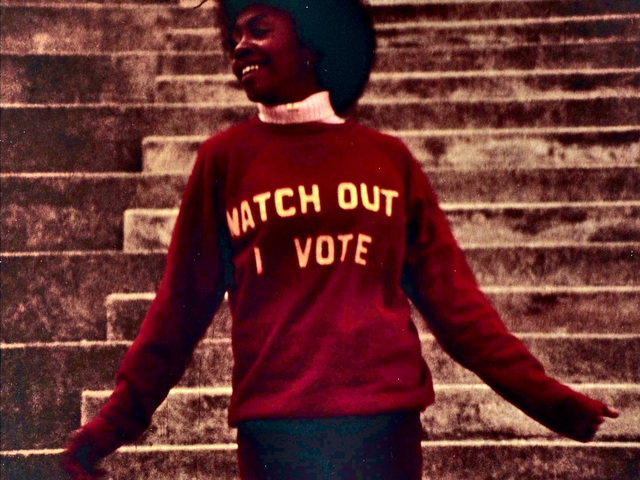
What resulted was Tellin’ the World, an exhortation to 18-to-24-year-olds to register and vote, to fix a nation beset by low wages, high prices, unaffordable housing, drugs, pollution, and an unpopular overseas war. The film’s narrators explain that if all eligible young voters were to register and go to the polls, they would form a voting block of twenty-five million in a country where only a few thousand votes had determined the elections of Presidents Kennedy and Nixon. Vietnam is brought up to reiterate the “old enough to fight, old enough to vote” argument and its deadly relevance: by 1970 almost half of the Americans killed in Vietnam were under 21. In accordance with Frontlash’s mission, the film avoids campuses or classes, instead showing multi-racial working-class young adults in urban public spaces and cityscapes, at leisure or working in construction or retail, bagging groceries or working on cars.
Providing the narration and title song are jazz musician Grover Kemble—brother of Frontlash’s founding executive director Penn Kemble—and Melissa Manchester, who won the 1983 Best Pop Female Vocal Performance Grammy for her hit “You Should Hear How She Talks About You.” The lyrics for “Tellin’ the World” were devised by Lynne Rhodes Mayer. Frontlash offered prints of the film for $75.00, or $7.50 for rental.
In the run-up to the 1972 Presidential election there were many predictions of the effect of the youth vote: that it would be decisive, or heavily favor the Democrats (Frontlash found the youths it registered favored the party roughly three to one), or prompt a youth takeover in cities with large student populations. All of the above were wrong. The election attracted only 55.6 percent of potential voters, and the young divided their votes equally, with Richard Nixon being re-elected in a landslide over George McGovern. According to a study by the Census Bureau, only 48 percent of those enfranchised by the Twenty-sixth Amendment had voted. 48 also happens to be the average percentage of eligible young voters (between 18 and 29) who have cast ballots in Presidential elections between 1972 and 2024. Voters aged 18 to 21 continue to have the lowest turnout of any age group. As for Frontlash, during the 1980s it was incorporated into the AFL-CIO and its attention turned away from voter registration to broader labor and international issues, worker rights, and boycotts against union busting corporations. The organization was disbanded in 1997.
About the Preservation
Harold and Lynne Rhodes Mayer donated their film and manuscript collection to the Wisconsin Center for Film and Theater Research in 2015. The WCFTR and Colorlab worked from a 16mm internegative and negative optical soundtrack to preserve Tellin’ The World, creating a digitally corrected liquid-gate film scan that was output to film to produce a new negative, soundtrack, and answer print.
About the Archive
The Wisconsin Center for Film and Theater Research is a part of the University of Wisconsin-Madison Communication Arts Department and works closely with the Wisconsin Historical Society. The WCFTR holds one of the world’s major archives of research materials relating to the entertainment industry, with over three hundred collections from outstanding playwrights, television and motion picture writers, producers, actors, designers, directors, and production companies. These include twenty thousand motion pictures, television shows, and videotapes, along with two million still photographs and promotional graphics. It holds the United Artists collection and papers from Kirk Douglas, Rod Serling, Agnes Moorehead, Walter Wanger, Stephen Sondheim, and Shirley Clarke.
Further Viewing
Harold Mayer Productions’ most acclaimed film, The Inheritance (1964), can be viewed in the NFPF’s Online Field Guide to Sponsored Films.