Automobile Thieves (1906)
We hope you will enjoy the following film. Please consider making a donation so that we can continue preserving films and presenting them on our Web site. Thank you!
The film will start in 0 seconds.

Film showing the Bayshore Amusement Park in its heyday, preserved by the Maryland Historical Society with NFPF support.
We hope you will enjoy the following film. Please consider making a donation so that we can continue preserving films and presenting them on our Web site. Thank you!
The film will start in 0 seconds.
Automobile Thieves (1906)
Production Company: Vitagraph Company of America. Producer/Director/Cinematographer: J. Stuart Blackton. Co-Director: William Ranous (?). Transfer Note: Scanned from a 35mm preservation print by UCLA Film & Television Archive. New Music: Michael Mortilla. Running Time: 16.5 minutes.
At the dawn of the Nickelodeon era, Vitagraph was the studio to beat, the one making the most exciting, and often most advanced, films. At the start of 1905 movies were the province of Vaudeville theaters, but by 1907 they had shifted to storefront venues solely dedicated to cinema, which screened 20 to 30 minutes of film in return for a nickel. Another momentous shift occurred during this period: narrative drama took precedence over the actuality. The triumph of fiction over putative fact was partly thanks to the popularity of crime and chase films. Vitagraph, founded in 1897, was at the forefront of these changes and by 1906 was making advances in cinematic technique—in the handling of space, camera movement, and editing—years in advance of D.W. Griffith’s more celebrated innovations at the Biograph Company.
Vitagraph was also an innovator in its organizational structure. By 1906 the company had two production units, headed by co-founders J. Stuart Blackton and Albert E. Smith; they handled the camera and collaborated with a stage director/manager, probably William Ranous in the case of Automobile Thieves. Soon afterward the company would add an extra unit and bring in more directors. Vitagraph’s set-up, with directors working under a central producer, would eventually lead to the Hollywood studio system.
1906 brought further innovations. Earlier in that year J. Stuart Blackton had secured a place in animation history with Humorous Phases of Funny Faces, a demonstration of object-animation techniques paired with stop-motion substitution. And in the November, around time of the premiere of Automobile Thieves, Vitagraph opened its new Brooklyn studio, the first modern movie plant in the US. The building’s glass-enclosed roof and upper section, along with its artificial lighting, encouraged more creative staging in interior scenes and allowed greater control over lighting and shadows. Location shooting meant lesser control, as demonstrated in Automobile Thieves: the shadow of the cameraman, busily cranking away, is plainly visible during the first auto theft.
The dynamic narratives and styles of Vitagraph’s films were strong meat, meant to appeal to urban audiences. A Brooklyn Eagle reporter visiting the Vitagraph office in 1906 reported that the scenario writer—in the case of Automobile Thieves, likely J. Stuart Blackton himself—“must have something happening every minute, allowing for no padding with word-painting, following climax with climax, and developing all kinds of intricate situations so that the interest of the onlookers will never sag from the picture on the canvas.”
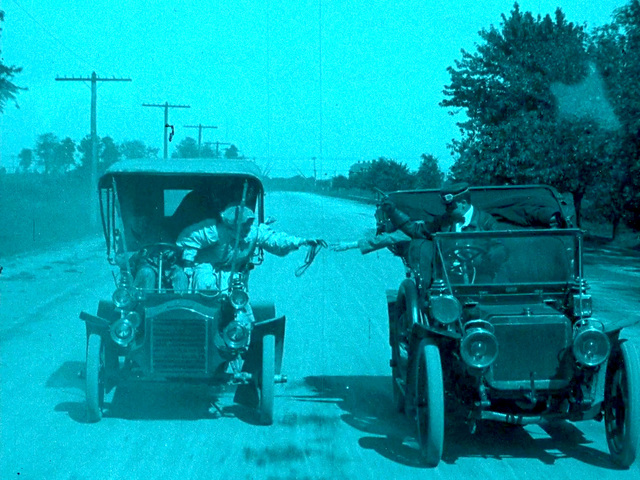
Automobile Thieves follows that directive to excess. Its anti-heroes, renegade lovers on the wrong side of the law, rampage through the film’s 28 shots with sociopathic verve, committing two burglaries, two auto thefts, a drive-by robbery, and highway robbery. In between they find the time to brutally club two victims, shoot two policemen, and light a stolen car on fire. The doomed, vicious couple, who use cars as crime accessories and enjoy a bullet-riddled grand finale, might strike modern viewers as forerunners of Bonnie and Clyde. The film’s original intertitles are missing, though probably there weren’t many to begin with, judging from Vitagraph’s other films from this period. Without them the narrative is mostly comprehensible, aside from the mystery of how the police find the location of thieves’ hideout.
Vitagraph advertised Automobile Thieves as “the acme of sensationalism” and ballyhooed the destruction of “a $2,000 automobile.” Here was was “the most thrilling and dramatic film ever produced,” a production “daringly realistic in plot and climax. NOT cheap, trashy, dime-novel melodrama.” And it could be rented at 12 cents per foot, either from Vitagraph’s New York and Chicago offices or its selling agents in San Francisco and London.
Actors were not yet named in movie ads, so the name of the film's lead actress remains a mystery. The male lead was likely played by J. Stuart Blackton, while the female has often been identified as Florence Lawrence, America’s first movie star. But according to James Norwood, author of an in-progress biography of Lawrence, this attribution is false, and arises from Lawrence’s mistaken recollections to Photoplay years later. Her first film with Vitagraph dates from no earlier than July 1907, a date corroborated by the most recent history of the company, Andrew A. Arish’s Vitagraph: America's First Great Motion Picture Studio (Screen Classics, 2022).
As Jon Gartenberg observed in his pioneering study of Vitagraph’s Nickelodeon era, by 1907 the studio had developed an innovative way of film drama that relied on parallel editing and the full use of space in interior scenes. The new Brooklyn studio had prompted these shifts in storytelling, which conveyed increasingly complex narratives through composition in depth and the staging of simultaneous action across succeeding shots. Such editing smoothly integrated interiors and exteriors, improving on the old technique of alternating exterior and interior action in blocks.
Automobile Thieves is a transitional film between the new and old styles. Its interior scenes hark backward, with their flat painted backdrops, theatrical staging, and stationary camera. So does the Vitagraph logo painted on a safe, a once common anti-piracy practice. Judging from their style, and the breezes blowing through them, the interiors were shot in Vitagraph’s old open-air stage above its New York office. The only interior that shows the stylistic influence of the films being shot on the in-construction new stage is the upstairs robbery. Avoiding flat backgrounds, the scene is centered on a corner of the room, to suggest spatial depth. Ahead and on either side of this middle-rear convergence are two crucial action points: the window the robbers emerge from, and the door used by the police. The cops and robbers struggle in the frame’s middle plane, directly behind a chair and table in the immediate foreground, partially creating a composition in depth.
This scene also makes use of simultaneous action in successive shots, with smooth cuts on action as the characters go from exterior (a ladder against the house wall) to interior (through the window into the room). When the male thief is surprised by a policeman inside the room, the film cuts to his girlfriend outside, who climbs the ladder and lifts her gun arm through window; a cut to the interior shows her pointing through it to shoot the policeman. The final shootout is also noticeable for its staging and centering: policemen charge from the left midground side of the frame and simultaneously descend to it from the upper right edge, while a dead body in the center foreground directs the eye to the battle raging behind it.
But the exteriors are where Automobile Thieves fully comes alive. The outdoors shots boast camera movement, as in the pan of the rich man alighting from his car to enter his soon-to-be-robbed mansion, immediately followed by a pan of the maid emerging from the front door to greet him before approaching her partner in crime, the chauffeur. More excitingly, the exteriors exploit the cinematic potential of automobiles in motion, with the drive-by robbery filmed from the back of a speeding camera car.
All the vehicular scenes exploit screen depth, taking full advantage of the car’s ability to diagonally traverse the image from the extreme background of one corner of the frame to the extreme foreground of another—with a speed far beyond that of any pedestrian. In the drive-by and highway robberies, cars trade diagonal movements across the frame, from the lower left foreground to upper right background and vice versa.
Even the less sophisticated uses of the camera are dynamic. In the cops-and-robbers car chase, soon to become a staple of the ensuing 120 years of cinema, the cars drive head-on toward the camera before making a last-minute turn to the right, just a few feet away from the lens. By 1906 the chase scene was already familiar to audiences, but Automobile Thieves brought new speed, style, technology, and brutality to the concept. The film imparts a time-honored lesson, one taken to heart by filmmakers throughout the decades: Crime does not pay…unless you make a movie out of it.
About the Preservation
Of the 121 films Vitagraph made between September 1905 and December 31, 1907, only 16 survive. UCLA Film & Television Archive preserved Automobile Thieves from the original 35mm nitrate negative, in cooperation with Warner Brothers, which absorbed Vitagraph in 1925. The project commenced in 1999, with funding provided by Saving the Silents, a Save America’s Treasures Project organized by the National Film Preservation Foundation, the National Endowment for the Arts, and the National Parks Service, Department of the Interior. Additional funding was provided by the Society for Cinephiles and Cinecon, Inc. In 2021 an NFPF grant funded scanning and digitization of the preservation print.
About the Music
The score for Automobile Thieves was created with an eye towards “melodramatic theatricality” and in keeping with the highly stylized and “exaggerated” performances, action and sets. The compositional process always starts with watching the entire film several times in silence, creating an actual narrative in my mind. I then improvise to picture for as long as it sustains the actual narrative of the story. As soon as the narrative seems lost, I go back and start over, each time (hopefully) getting a little further into the story. By around a half dozen times doing this, the score has taken shape and is precisely repeatable, even without watching the film, to the point where I could work away from the keyboard and note the entire score from memory. The recording of this music was accomplished in a continuous, unedited, performance. — Michael Mortilla.
Michael D. Mortilla is a self-taught composer and pianist. He has composed for Martha Graham, the Chicago Symphony, 1996 Olympics, Library of Congress, Academy of Motion Picture Arts & Sciences, CALARTS, Sony/Columbia, Severin Films, dozens of scores for the NFPF and literally thousands of productions in film, theater, dance, puppetry, animation, magic, comedy, and the concert hall. In 1984 Michael was granted a teaching license by the City of New York, subsequently moving to California in 1986 to teach at UC Santa Barbara. In 2000 Michael relocated his studio to Burbank, where he currently resides, maintaining an active schedule of composing and performing.
Further Reading and Viewing
Jon Gartenberg’s “Vitagraph before Griffith: Forging Ahead in the Nickelodeon Era” (Studies in Visual Communication vol. 10, no. 4, Fall 1984) is a groundbreaking analysis of how Vitagraph became the leading studio of that era. Automobile Thieves is highlighted in The Emergence of Cinema: The American Screen to 1907 (University of California Press, 1994) by Charles Musser. James Norwood is at work on the final chapters of The Films of Florence Lawrence, the First Movie Star’s Life in Pictures 1886-1938.
The NFPF website offers a sampling of the films Vitagraph made in the years shortly after Automobile Thieves, including the surreal comedy The Thieving Hand (1908), the trick film Princess Nicotine; or, The Smoke Fairy (1909), and Jean the Match-maker (1910), a vehicle for Jean the Vitagraph Dog, America’s first canine movie star.