The Girl From Frisco: Episode 24 (1917)
We hope you will enjoy the following film. Please consider making a donation so that we can continue preserving films and presenting them on our Web site. Thank you!
The film will start in 0 seconds.

Film showing the Bayshore Amusement Park in its heyday, preserved by the Maryland Historical Society with NFPF support.
We hope you will enjoy the following film. Please consider making a donation so that we can continue preserving films and presenting them on our Web site. Thank you!
The film will start in 0 seconds.
The Girl from Frisco: Episode 24: The Wolf of Los Alamos (1917)
Production Company: Kalem Company. Distribution Company: General Film Service. Director: James W. Horne. Writer: Robert Welles Ritchie. Cast: Marin Sais (Barbara Brent), Frank Jonasson (Ace Brent), True Boardman (John Wallace), Edward Clisbee (Jose). Preservation Note: Scanned by the Library of Congress from a 35mm preservation print. New Music: Michael Mortilla. Running Time: 25 minutes.
According to press announcements, “Kalem’s decision to produce The Girl from Frisco was prompted by the timeliness of the theme of women’s equality with man in the business world and the growing demand from exhibitors for stories of the rugged Western type.”
The Girl from Frisco starred Marin Sais as Barbara Brent, the strong-willed daughter of a western rancher: “Born and bred in the free air of a western ranch, trained to ride and shoot, educated at the best schools and given every advantage of wealth and social position, Barbara Brent is endowed with the proper qualities for a heroine of modern romance.” Moreover, “in defending her father’s vast interests against his powerful enemies Barbara meets men on their own battleground and proves by her deeds her contention that woman is man’s equal in any undertaking.” Her love interest, played by True Boardman, was Congressman John Wallace, “an admirer of Barbara Brent who does not however believe in her theories of woman’s independence.”
Producing The Girl from Frisco was a natural move for Kalem. Founded in 1907, the studio had specialized in railroad westerns and Civil War dramas, and was the first studio to regularly endow those films with vigorous young female protagonists. Kalem’s “plucky girl” formula paved the way for the “serial queens” (Pearl White, Ruth Roland, Helen Holmes), who entered movies in 1912 with the first serial, Edison’s What Happened to Mary. Kalem reacted by rejecting serials and making series, consisting of self-contained two-reel episodes. “Is your patronage suffering from ‘Serialitis’?” it asked exhibitors, touting that an episode in a Kalem series told a complete story and could be booked in any order. Kalem’s most famous series was The Hazards of Helen; its 119 episodes ran from 1914 to 1917, longer than any other series or serial.
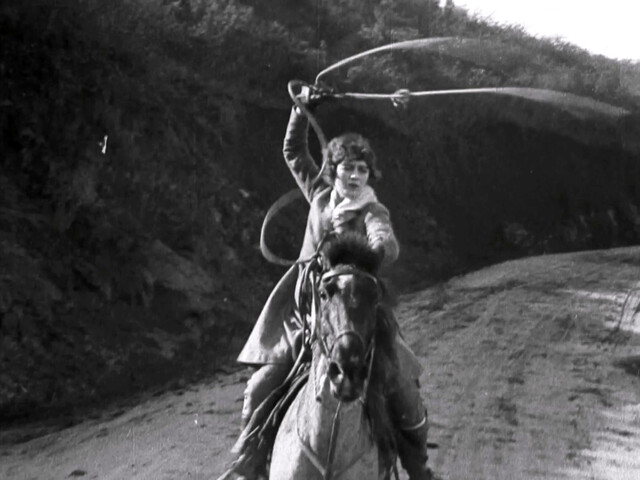
Though tecnically a series queen, The Girl from Frisco’s Barbara Brent nevertheless fit the profile of a serial queen, being the motherless daughter of a powerful father who she repeatedly saves, thereby inverting patriarchal control. Barbara, like the serial queen, also resided in a primarily male, non-domestic world, whose denizens she could nevertheless out-compete on any occasion. In this episode, The Wolf of Los Alamos, Barbara lassoes her own father in an unsubtle display of dominance and gives orders that delegate lesser heroics to him and his ranch hands. She does the detective work of uncovering a thieving murderer and preventing the lynching of Jose the vaquero. She also single-handedly brings the villain to justice, by lassoing him as expertly as she lassoed her father.
“Marin Sais as Barbara Brent shows of what sterling stuff she is made,” raved the Motion Picture News review of The Wolf of Los Alamos. “The picturization is good, and exteriors in some instances are remarkable and Marin Sais also proves herself an adept with lariat. The picture should prove a winner.” Marin Sais was born Mae Smith in San Rafael, California; she created her stage name by combining her birth county with the surname of her great-uncle Domingo Sais, the head of a Mexican land grant family. She joined Kalem in 1910 and was among its top stars, headlining several series—Mysteries of the Grand Hotel (1915), Stingaree (1915), and The Social Pirates (1915)—under the direction of James Horne, who would also direct her in The Girl from Frisco. Sais owned a ranch in Utah and was an expert horsewoman; in The Wolf of Los Alamos she rides her favorite mount, Blue Devil. Though interiors for Frisco were filmed in Kalem’s Glendale studio, the series took pride in traveling widely for locations. The titular Los Alamos was (and still is) a small, unincorporated town in Santa Barbara country, 140 miles northwest of Los Angeles.
“They are not the usual clap-trap, ‘sheriff-on-the-run’ style of Western films,” Kalem declared of The Girl from Frisco. “They are red-blooded, wholesome stories of the Far West as it is today.” This was the “new West, the West of irrigation projects, oil fields, mining interests and ranching.” This is evident from reading the trade press descriptions of lost episodes. In episode 16, The Fight for Paradise Valley, Barbara and her Congressman boyfriend “wage a bitter battle with the ‘Water Trust’ which attempts to prevent their successful completion of the irrigation project.” And in episode 12, The Harvest of Gold, the “Fruit Syndicate” attempts to corner the orange crop and drive out independent growers. Since serials and series screened in second-run downtown theatres or in small neighborhood ones “catering to the working classes”—to quote a Chicago exhibitor who reported that Frisco had increased attendance by 30 percent—these tales of the modern west reflected populist concerns.
That populism extended to The Girl from Frisco’s attitude toward immigrant labor, best described as violently negative. In episode 21, On the Brink of War, “Barbara Brent aids in the campaign to elect John Wallace to congress, on a platform demanding the exclusion of Mexicans.” He gets elected, but not before bringing the US and Mexico to the brink of war and indirectly causing “a pitched battle between the Americans and the Mexican population of a Western town.” In episode eight, A Battle in the Dark, “Barbara and John Wallace lead a bitter struggle against encroaching Hindu labor that brings about a spectacular climax in a pitched battle between Hindus and ranchmen.” Episode 24, The Wolf of Los Alamos, continues the animus toward Indian immigrants with its turbaned villain “Raghun, the Hindoo cook,” obviously played by a white actor in face paint. Barbara realizes Raghun is the real murderer by noticing a mark of cultural otherness: the footprint left by his sandal—hardly cowboy footwear.
Indian migrant workers were very much a feature of the “new west.” Between 1899 and 1913 conditions in British-ruled India spurred emigration from the Punjab province. Approximately 7,000 Punjabis headed to the US, passing through the Immigration Station at Angel Island in San Francisco Bay before heading to the Sacramento, Imperial and San Joaquin valleys, where they labored in agriculture. The majority were Sikhs but indiscriminately referred to as “Hindoos,” as we see in the case of the turban-wearing Raghun.
Nativist attitudes toward Indian immigrants, who were accused of supposedly taking jobs away from whites by working for lower wages, were violently discriminatory. In 1907 the Japanese and Korean Exclusion League renamed itself the Asian Exclusion League and caused “Anti-Hindu” riots on the west coast. In 1913 California’s Alien Land Law prohibited “aliens ineligible for citizenship,” namely South and East Asians, from owning property. The Immigration Act of 1917, passed by the US Congress, halted immigration from India or anywhere else within a “barred zone” stretching from the Middle East to Southeast Asia. And in 1923 the Supreme Court ruled, in U.S. v Bhaghat Singh Thind, that Indian immigrants could not become naturalized US citizens.
Ironically The Girl From Frisco also screened in India—at the Ripon Theater of Madras—though surely for a colonial rather than native audience. How popular it was abroad is unknown (screenings also occurred in Spain and Singapore), but the series received an enthusiastic stateside response, with raves from exhibitors in Kansas City (“record business all over the territory”) and Stockton, CA (“the best drawing series ever shown on our screen”) and requests for rebooking by popular demand in Knoxville, TN, and Flint, MI. Kalem responded by extending the series from 15 to 25 episodes; The Wolf of Los Alamos was the penultimate one. Marin Sais quickly moved on to another series, The American Girl, again playing a western heroine.
But by 1917 it was growing difficult for a studio to survive solely from shorts, and Kalem was unwilling to take on the financial investment and risks of feature film production. The company was sold off to Vitagraph the same year. Marin Sais went on to play alongside her husband cowboy star Jack Hoxie in his own westerns. Director James Horne remployed his speed and vigor into comedy, notably with the cult classic The Cruise of the Jasper B (1926), and was assigned to Buster Keaton’s College (1927) prior to guiding Laurel and Hardy through Big Business (1929) and Way Out West (1937). He returned to the series/serial in the final stage of his career, bringing a self-mocking touch (“life, I think, always has an under-vein of comedy”) to Columbia’s The Green Archer (1940, the inspiration for DC Comics’ Green Arrow), Holt of the Secret Service (1941), and Captain Midnight (1942).
About the Preservation
Only three out of 25 episodes of The Girl From Frisco have survived. In 2007 Library of Congress received an NFPF grant to preserve its nitrate print of The Wolf of Los Alamos. The preservation print was scanned in 2022. Since the print is missing its opening title (the one you see in this presentation is a recreation), the film was for several years misidentified as episode 11, The Yellow Hand. Nitrate decomposition is prevalent toward the end but the story is complete.
About the Music
The main theme used in The Girl from Frisco is from a popular children’s song entitled “Playmates,” ostensibly written by Saxie Dowell. The main theme was note-for-note plagiarized by Dowell, lifted from a 1904 intermezzo “Iola” by Charles L. Johnson. Johnson sued Dowell, settling out of court for an undisclosed sum. My experience with the tune dates back to the early 1980s when it was employed in a modern dance work by choreographer Rebecca Bryant and danced in concert by my wife, Beth Burleson. The compositional process, as in many of my scores, is to play through the film about a half dozen times. By that time I can usually notate the music completely from memory. The recording of this music was accomplished in a continuous, unedited, performance. — Michael Mortilla.
An award-winning composer and sound designer, Michael Mortilla’s extensive work in New York theater and years working directly with Martha Graham informs his attention to narrative, movement, and expression. Largely self-taught, he received his teaching license from the City of New York Public Schools and was faculty/resident composer at UC Santa Barbara for 14 years. Mr. Mortilla regularly composes and performs for the Academy of Motion Pictures. Other commissions are from Sony/Columbia Pictures, The Chicago Symphony, the Olympics, and, of course, many scores for the National Film Preservation Foundation.
Further Reading and Viewing
The Girl from Frisco, serials, series, and the “serial queen” are illuminatingly discussed in Ben Singer’s Melodrama and Modernity: Early Sensational Cinema and Its Contexts (Columbia University Press, 2001). The NFPF website hosts a sampling of Kalem’s earlier films with their customary active heroines, including the Civil War dramas The Darling of the C.S.A. (1912), starring Anna Q. Nilsson, and The Confederate Ironclad (1912), along with the Western comedy Walk,—You, Walk! (1912), starring Marin Sais.